
Why I Built Don't Bother
Originally posted on dontbother.app.
A few months ago I went from being the one doing the hiring to the one looking for a job. That shift in perspective changed everything I thought I knew about the job market.
The View From the Other Side of the Desk
As a hiring manager, every position we posted was flooded with applications. Modern tooling and remote work have made it trivially easy for applicants to spray the market with resumes. Some are well-meaning people trying to maximize their chances. Others are more concerning — I've personally been in an interview with someone who turned out to be faking their entire identity using AI. Nation-state actors are now leveraging AI to fabricate every part of the application process, from the resume to the live interview.
Even setting aside the outright fraud, the noise is overwhelming. AI resume tools stuff documents with keywords to get past filters, whether the applicant actually has that experience or not. The output is so formulaic that I wrote a parser to weed out resumes that matched certain patterns. That's where we are: hiring managers writing code to detect the code that applicants are using to game the system.
Then I lost my job, and suddenly I was on the other side.
The Problem With "Apply to Everything"
I went from the challenge of finding a needle in a haystack to trying to figure out how to be the needle. And I quickly realized a few things.
If I wasn't a genuinely good match, I wasn't going to get a callback. Not because the system is fair — but because there are simply too many resumes that look like a good match, whether they're real or fabricated. The volume guarantees that someone with the right keywords will be ahead of me.
Even when I was a good match, it was hard to stand out. Tailoring a resume takes real time — emphasizing the relevant experience, cutting the rest. And then there's the cover letter. I often didn't read them myself as a hiring manager; a long, overwrought one was actually a negative, especially when it was clearly AI-generated. But I still dreaded skipping it. What if this hiring manager values them? So I'd agonize over writing something that felt sincere instead of formulaic, knowing from experience that the AI-generated version would be obvious.
Each application done properly takes hours. Research the company. Research the position. Tune the resume. Write the cover letter. It's exhausting. And when you've recently lost your job, the pressure and anxiety make it easy to start focusing on quantity instead of quality. I started cutting corners instead of doing my best work.
It's easy to mistake the number of applications submitted for "working hard." People around you might even ask or judge based on that number. But it's not about the quantity. Imagine someone frantically casting a net with holes too big to catch anything useful. When they finally do catch something, it might not be what they wanted. Better to dive in with a spear gun and go after the right one.
The Tools That Were Supposed to Help
I tried the apps that promise to help — Teal, Simplify, and others. They're helpful-ish. But I found that I couldn't trust them.
Some were inventing experience I didn't have. Making up statistics in patterns that were very familiar to me from my time filtering resumes. Using that unmistakable AI language that erases any personality and makes everything sound horribly generic. I recognized the output because I'd been throwing it in the reject pile just months earlier.
So I'd end up spending the time reviewing and rewriting the output anyway, which defeated the purpose.
And here's the thing none of these tools would do: tell me not to apply. Every tool in the market is designed to help you apply faster, to more jobs. Their business model depends on volume. None of them will look at a job posting and say, "This isn't a good match for you. Don't waste your time."
What I Actually Needed
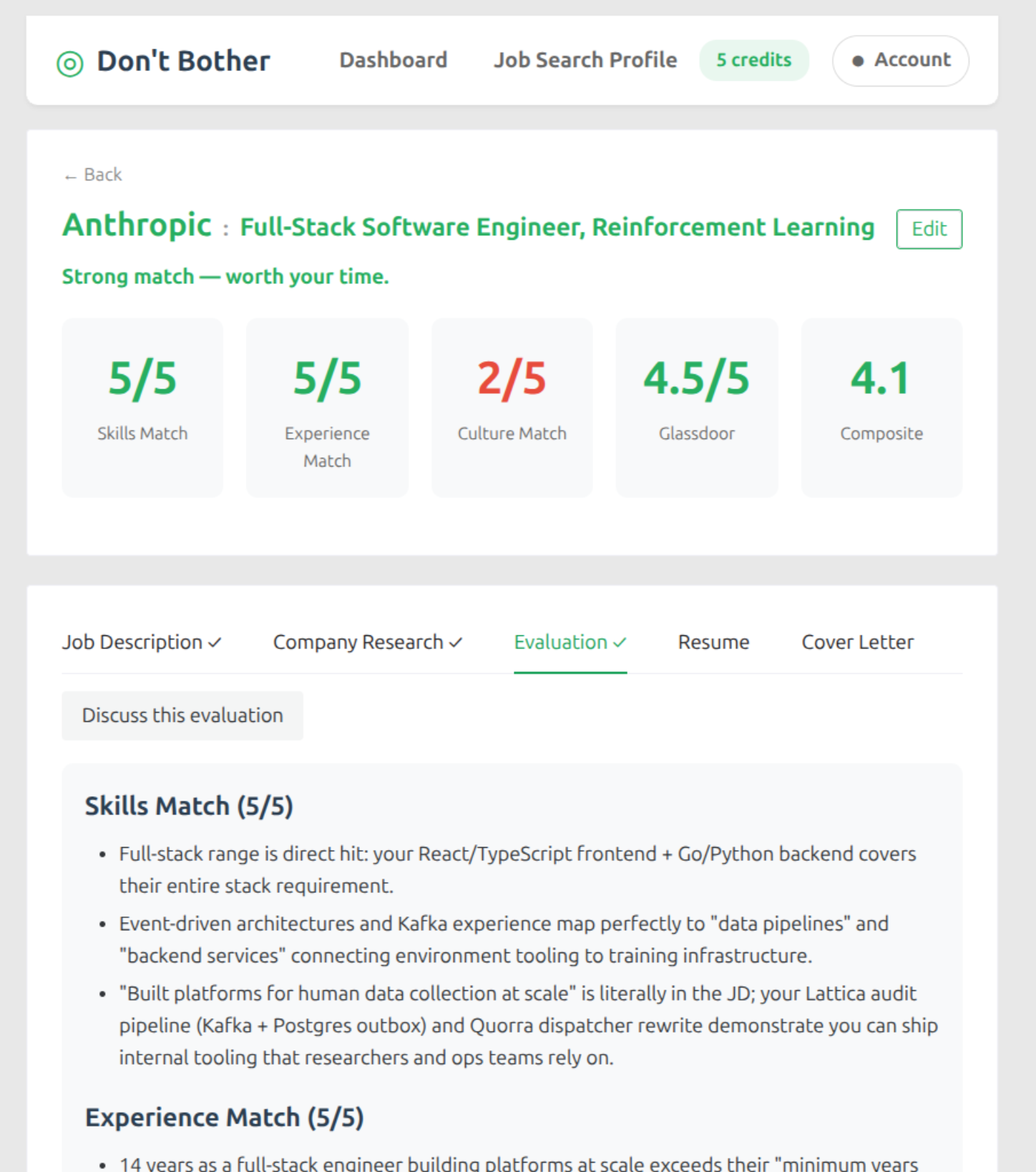
I needed something that could be brutally honest with me. Something that could look at a job posting and my actual background and tell me whether it was worth spending hours on an application — or whether I should move on and spend that time finding the right role.
I needed to externalize that decision to something that wasn't affected by anxiety, urgency, or the pressure to just do something.
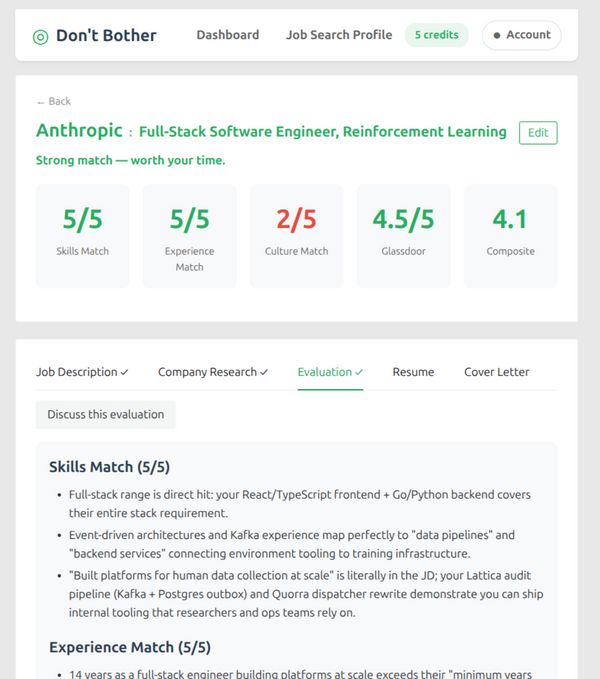
So I built it. I gave an AI agent deep context about my career — not just my resume, but my actual experience, the kinds of roles I'm suited for, what I'm looking for in a company. Then I tuned it to research companies, analyze job descriptions, and give me an honest assessment of whether I should bother applying.
And if it was a good match, it would help me customize my resume and cover letter in a way I actually trusted — because it knew my real background and wouldn't invent things I hadn't done.
Why I'm Sharing It
I'll admit — almost anyone could build something like this today with enough time and patience. AI tools are accessible enough that you could cobble together your own version in hours instead of the days or weeks it would have taken before.
But the real value is in the hours I've spent tuning and optimizing the agents, prompts, and questions to produce a truly unique and quality result. I've heard this called "context engineering" recently, and it might be where real unique value that an application might have in this new AI world. But perhaps most importantly, it reduced my stress and workload so much that I wanted to share it and hopefully ease the anxiety of the job search for others as well.
It's the tool I built because I needed something honest in a market full of tools that just tell you what you want to hear. It won't invent experience. It won't generate generic AI-speak. It will save you time by telling you when not to apply, then help you truly optimize the applications worth your time.
If that sounds useful, the full project lives at dontbother.app.